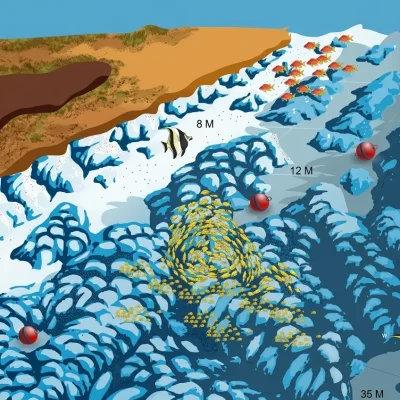
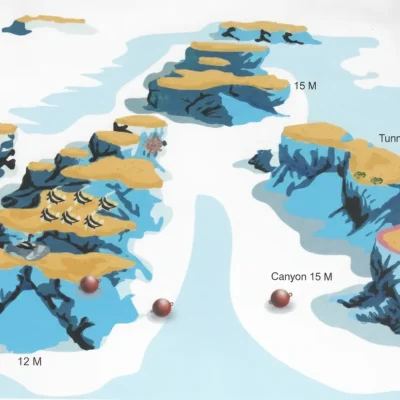
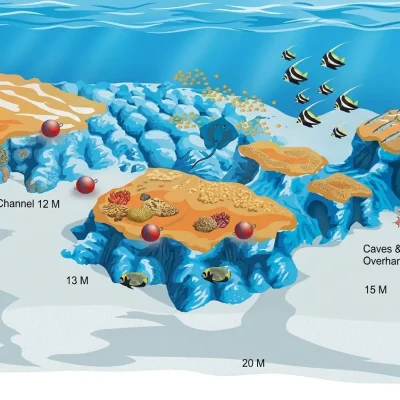
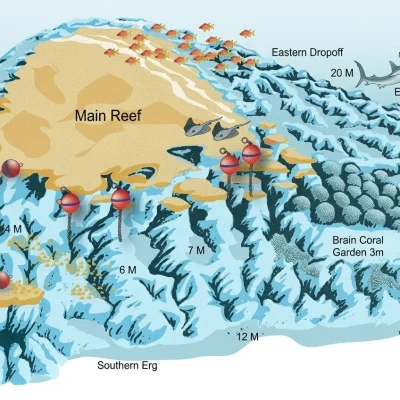
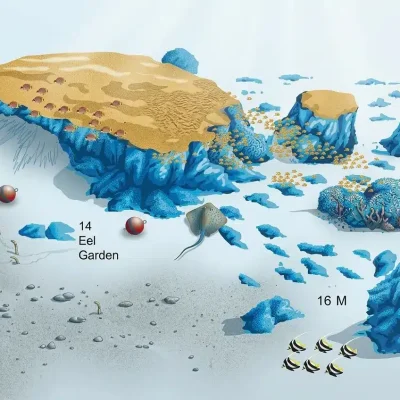
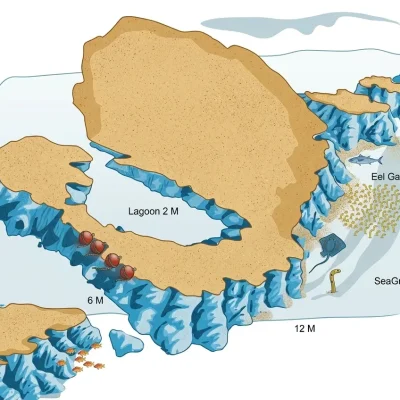
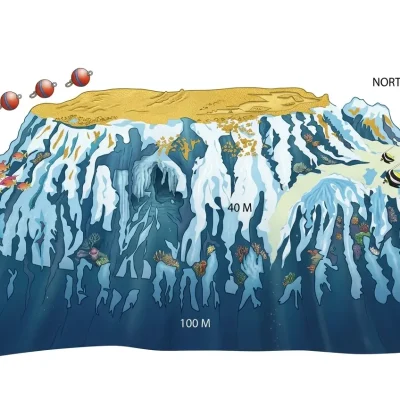
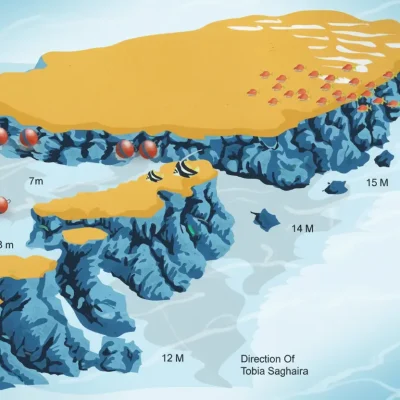
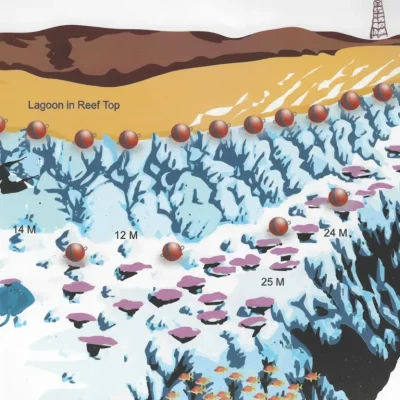
Gamul Al-Saghir (also written Gamul el Soghira) is a small, round reef lying just outside Safaga, the second in a chain of reefs that stretches northwards from Safaga Island. The main reef rises from a sandy seabed to a shallow top, and to the southeast four outlying pinnacles (ergs) sit on the sand, two of which break the surface and two that remain submerged. This compact layout, combined with easy depths and nearby seagrass and eel gardens, makes Gamul Al-Saghir a favourite for beginner dives, check dives, and relaxed reef explorations close to port.
You can usually reach Gamul Al-Saghir in almost any weather, and it is often chosen when conditions are too rough to reach the outer reefs. The reef’s position close to the coast and its rounded shape provide good protection from swell, so surface conditions are typically calm to slightly choppy, even on windy days. The prevailing current comes from the north and splits around the reef, running down either side; it is most often mild, though you can feel it a bit more around the corners and pinnacles. Overall, the site is considered suitable for all levels, offering safe conditions for training and beginners while still being diveable on days when more exposed reefs are not an option.
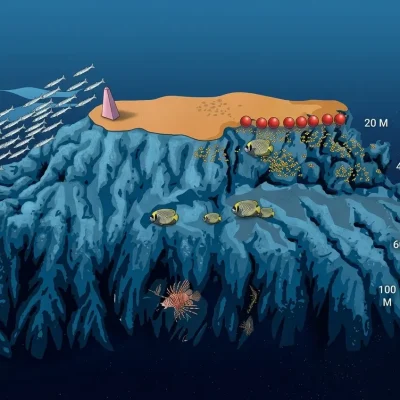
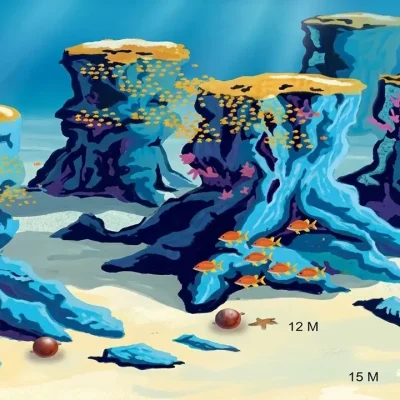
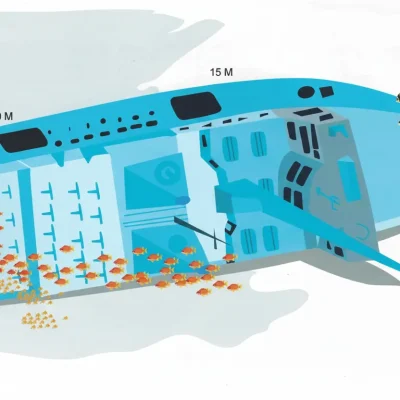
A classic dive at Gamul Al-Saghir starts from the mooring on the main reef and heads directly toward the southeastern ergs, passing an eel garden on the sand along the way. The first large erg nearest the main reef reaches from about 13 m up to the surface; just beyond it, at around 16 m, stands a hollow pillar about 6–7 m high with a gorgonian inside. Roughly 60 m further south you reach a very picturesque horseshoe-shaped erg, and about 70 m beyond that lies the most impressive erg, which rises to the surface from 18 m and is heavily overhung on its south side. After touring the ergs and enjoying the overhang teeming with glassfish, hatchetfish, cardinalfish, silversides, and their predators, you check your gas: with more than 100 bar, you can continue around the main reef; with less, you make a slow, relaxed return to the boat along the reef slope.Marine life On the ergs and main reef, you can expect dense schools of bream, batfish, bigeye emperors, sweetlips, bannerfish, fusiliers, red and black snappers. The overhangs and glassfish clouds attract predators such as redmouth groupers and lionfish, which hunt in and around the shimmering baitfish. On the main reef itself, numerous crevices harbour squirrelfish, soldierfish, glasseyes, and cardinalfish, while sweetlips often school alongside snowflake groupers and resident lionfish. Blue-spotted stingrays are commonly seen on the sandy areas, and the eel garden section adds extra interest with its fields of shy garden eels swaying above the sand.
On the ergs and main reef, you can expect dense schools of bream, batfish, bigeye emperors, sweetlips, bannerfish, fusiliers, red and black snappers. The overhangs and glassfish clouds attract predators such as redmouth groupers and lionfish, which hunt in and around the shimmering baitfish. On the main reef itself, numerous crevices harbour squirrelfish, soldierfish, glasseyes, and cardinalfish, while sweetlips often school alongside snowflake groupers and resident lionfish. Blue-spotted stingrays are commonly seen on the sandy areas, and the eel garden section adds extra interest with its fields of shy garden eels swaying above the sand.

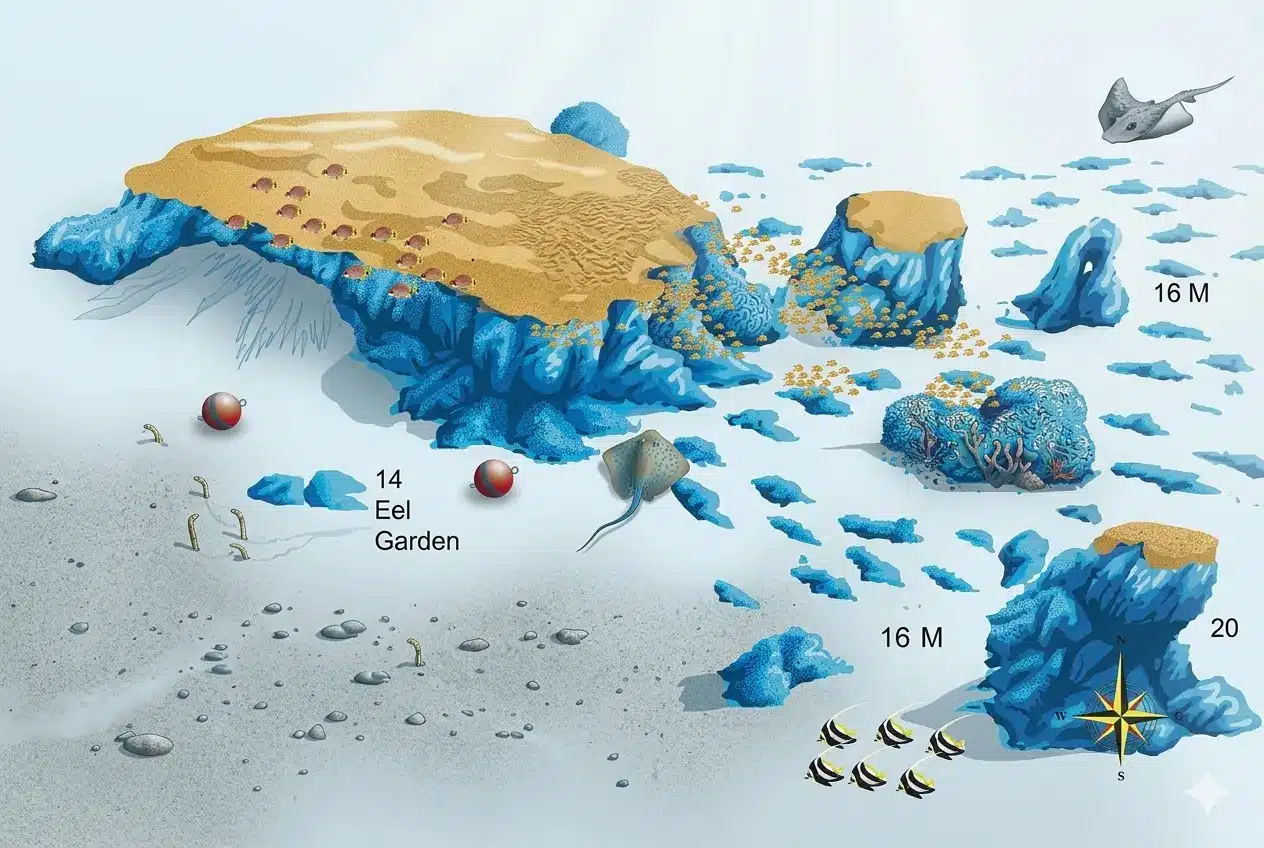
Approx. 5–20 m over sand, eel garden, and ergs, ideal for long no‑deco dives
Easy entry and very light currents. Great for first Red Sea dives.
Second reef north of Safaga Island, a few minutes by boat from Safaga/Soma Bay.
Around 22–24 °C in winter, 23–25 °C in spring, 27–29 °C in summer, 26–28 °C in autumn (Safaga averages).
About 15–20 minutes from Safaga/Soma Bay by boat, depending on wind conditions and boat speed.